Does Replying To Comments Faster Get A Video Recommended?
Somewhere between “post consistently” and “study your retention graph” there is a piece of advice that has hardened into folklore: reply to your comments quickly, especially in the first day, and the video will be pushed to more people. It is repeated confidently, usually with a story attached about a video that came back to life after a handful of replies.
I answer comments most days and have done since 2017, across faceless channels aimed at viewers in the US, the UK, Germany and Japan. I think the habit is worth keeping. I also think the reason usually given for it is wrong, and that the wrong reason leads people to do the work in a way that produces nothing.
The claim, and what can actually be checked
Nobody outside YouTube can verify that reply speed feeds into how a video is distributed. Not creators with large channels, not the people writing the articles, not me. The system is not documented at that level of detail, and the anecdotes have an obvious problem: a video that gets a burst of comments worth replying to was already doing something, so you cannot separate the replies from whatever caused the comments.
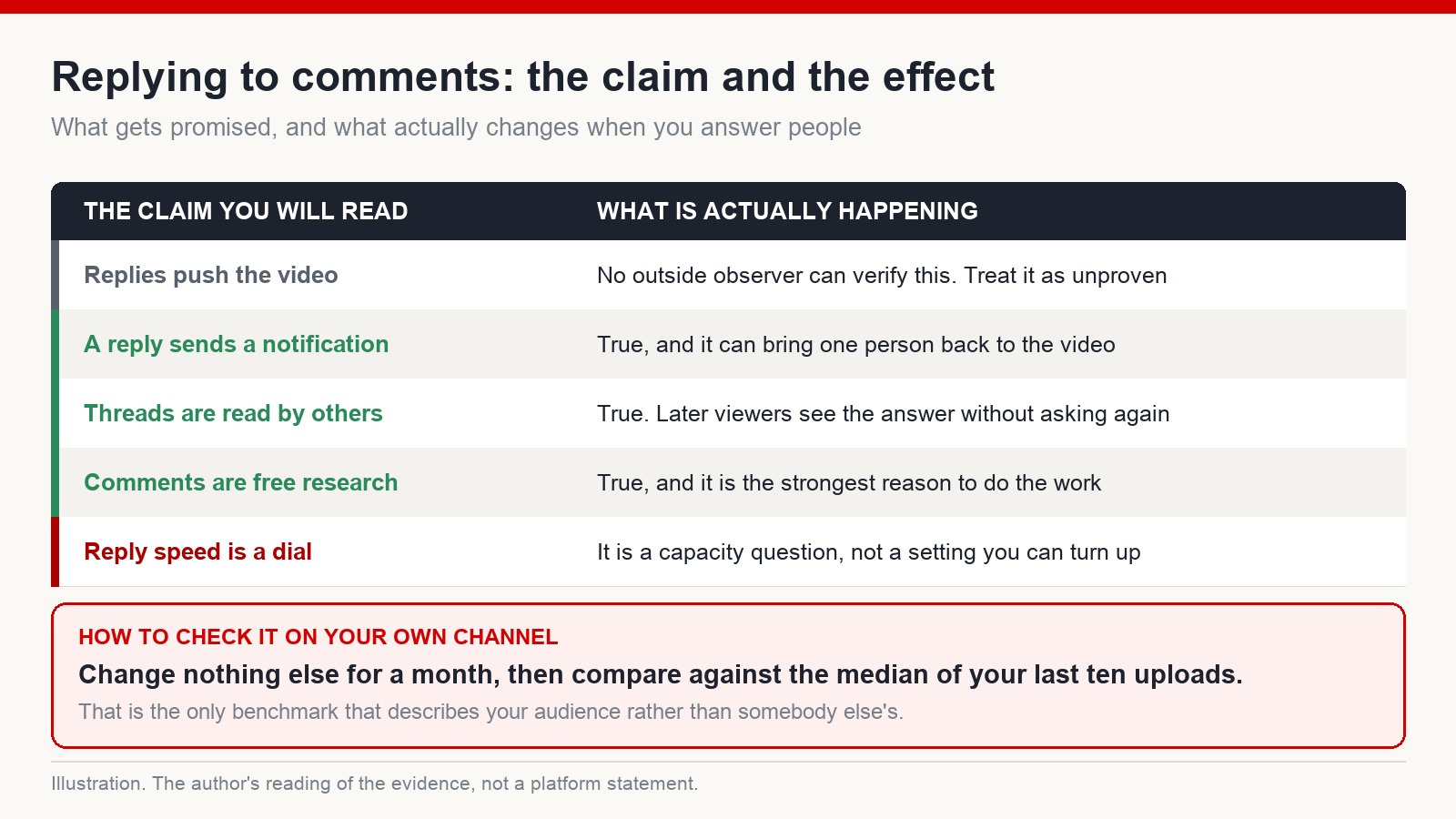
So treat the reach claim as unproven and set it aside. What is left is not a consolation prize. It is three effects you can observe directly, and they are the reason to do the work.
A reply sends a notification. One person, who already watched enough of the video to comment on it, gets a nudge that brings them back. That is not a growth strategy. It is one returning viewer, which is a real thing and worth having.
Threads are read by people who never write anything. This is the effect most people underrate. For every person who asks a question, a much larger number wondered the same thing and scrolled instead. Your answer is sitting there for all of them. A comment section with real answers in it is a second, shorter version of the video.
Comments are the cheapest research available. When three separate people ask about the same step, that is not three comments. That is the next video, with its title already written by the audience. Nothing else in the creator toolkit gives you that for free.
Reply speed is a capacity question, not a dial
The first day gets talked about as though there were a window to hit. There is a reason to be around early, but it is a human one rather than a mechanical one: the people commenting in the first hours are the people who chose to watch immediately, and they are the closest thing to an audience you have. Being present while they are present is how a comment section develops a character.
What that does not mean is that a reply at hour two is worth more than a reply at hour thirty. Treating speed as a lever produces the worst version of this work – a rushed pass of one-word answers posted to hit a deadline nobody set. Two thoughtful replies on day two beat forty empty ones on day one, and the person who receives a real answer notices which they got.
What to do when you are hundreds behind
The advice to reply to everything works for about three weeks. Then a video does better than usual, the backlog becomes unclearable, and most people respond by giving up on the comment section entirely.
The way out is to stop treating every comment as the same object. Three passes, in this order.
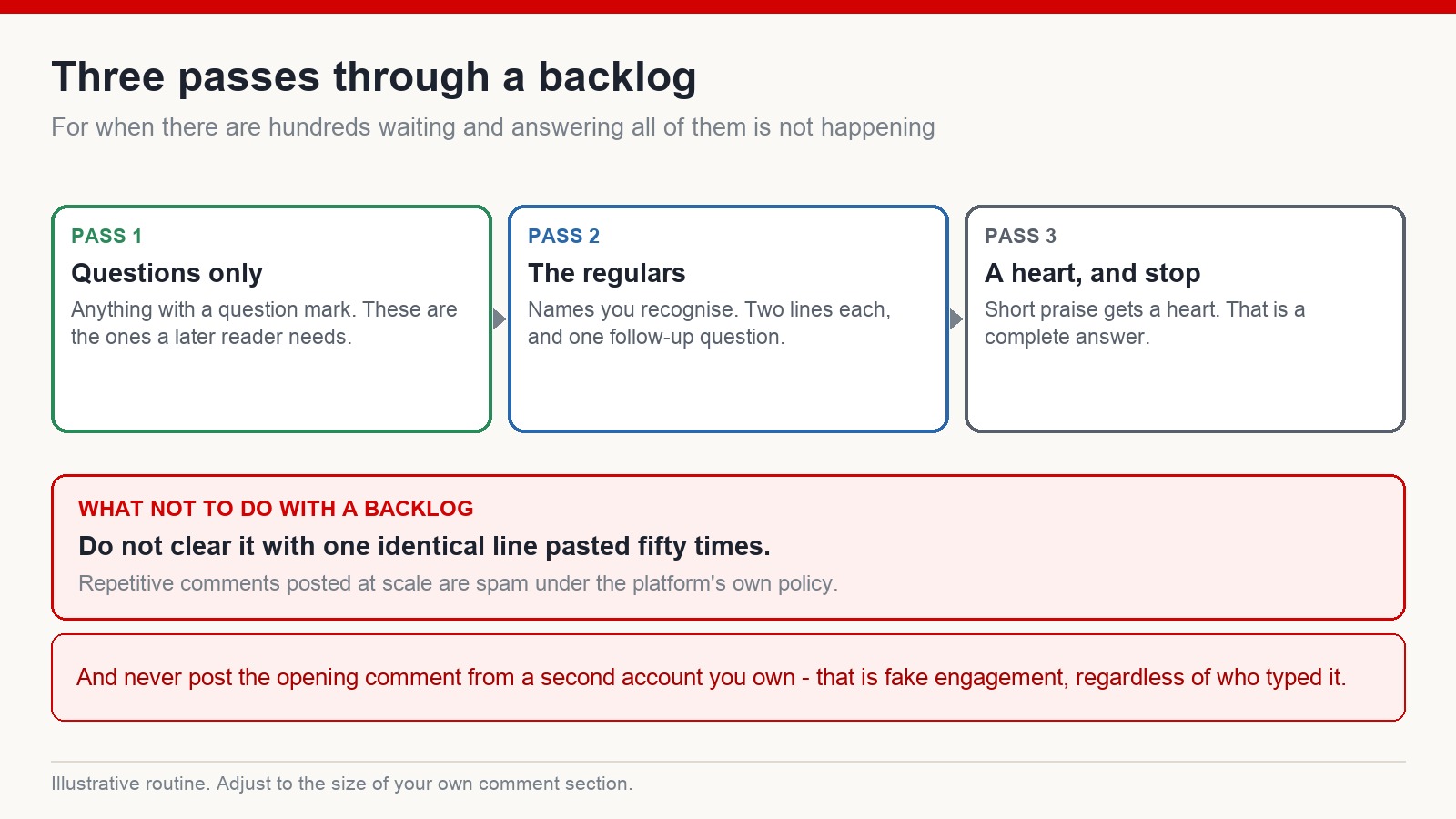
Pass one: questions only. Filter for anything with a question mark and answer those first. These are the comments a later reader benefits from, and they are the ones where a missing answer is actually a loss.
Pass two: the names you recognise. People who turn up repeatedly are the closest thing a channel has to regulars. Two lines each, and end with a question rather than a full stop, because a reply that ends in a question gives them somewhere to go.
Pass three: a heart, and stop. “Great video” gets a heart. That is a complete response. It takes a second, the person sees that you saw it, and you have not spent your evening typing thank-you notes.
Permission to not reply to everything is the part people need most. A comment section where the questions are answered and the praise is acknowledged reads as attended to. A comment section where every single entry has a generic reply underneath it reads as automated, which is the opposite of the impression you were going for.
The two shortcuts that go wrong
Both of these come up whenever the backlog gets large, and both are worse than leaving comments unanswered.
The first is clearing a backlog with one identical line pasted underneath fifty comments. Repetitive comments posted at scale sit under YouTube’s spam and deceptive practices policy, and the fact that a human pressed the button each time does not change what the pattern looks like. It also fails on its own terms – a viewer who scrolls past four identical replies has learned that yours mean nothing.
The second is posting comments from a second account you own to make the section look busy, or to start the conversation so real viewers will join in. This gets described as priming, and under the policy it is fake engagement: engagement that does not come from a real person with genuine interest. The documented consequences run from the metrics being removed to the channel being terminated, and separate emails or isolated browser profiles do not put it in a different category, because the category is about who the account belongs to.
It also destroys the one thing that made comments valuable. A comment you wrote yourself teaches you nothing about your audience, and research was the strongest reason to be down there in the first place.
Using a writing tool, and where the line sits
Drafting a reply with a writing tool is fine, particularly when the comment is in a language you do not speak well. The condition is that you read what it produced and rewrite it in your own words before it goes anywhere. A reply that reads like a support ticket undoes the reason for replying, and a mass-generated set of them lands you back in the paragraph above.
How to check any of this on your own channel
If you want to know whether the habit does anything for you, run it as an actual experiment. Keep everything else the same for a month – same upload rhythm, same kind of packaging – and change only how you handle comments. Then compare against the median of your own last ten uploads rather than against a figure from an article.
You may well find the view numbers barely move. What tends to move first is subtler: more returning viewers, more comments that are about the topic instead of the thumbnail, and a much shorter gap between wondering what to make next and knowing.
Do I need to reply within the first 24 hours?
It helps to be around while the early viewers are, because that is when a conversation can actually happen. There is no evidence of a window that closes, and a good reply on day three is still a good reply.
Should I reply to comments on videos from a year ago?
Yes, when there is something worth saying. Someone who found an old video and took the time to write is exactly the kind of viewer worth answering, and the answer stays visible for everyone who arrives after them.
Does hearting a comment count as engaging with it?
For the person who wrote it, yes – they get a notification and they know you saw it. It is the correct response to short praise and it costs you a second.
Is there a minimum number of comments a video needs?
No, and chasing a number is how people end up with hollow comment sections full of single characters. A small number of real conversations is more useful to you than a large number of prompted responses.
What about hostile comments?
Hide them or ignore them. Arguing under your own video is a poor use of an evening and it is the first thing new viewers read. Report anything that crosses into harassment rather than engaging with it.
The short version
Nobody can tell you that answering comments faster gets a video recommended, so do not do it for that. Do it because a reply brings one person back, because the thread teaches everyone who reads it, and because your next video is already written somewhere in there. Then measure the effect against your own history rather than against somebody’s claim.
If you want the rest of the process for building a faceless channel for an English-speaking audience, that is what we work through at mmoyoutube.com. Results vary, and platform policies change – read the current one yourself rather than relying on any summary, including this one.